Home / Compare / Munich vs Stockholm
Munich vs Stockholm: downtowns compared
On foot, central Munich reaches about 2,500 everyday places in 15 minutes, against about 1,700 in Stockholm. Stockholm gives more of its center to parking (0.6% of the land, against 0.4%). Stockholm has the more regular street grid (order score 0.19 vs 0.18).
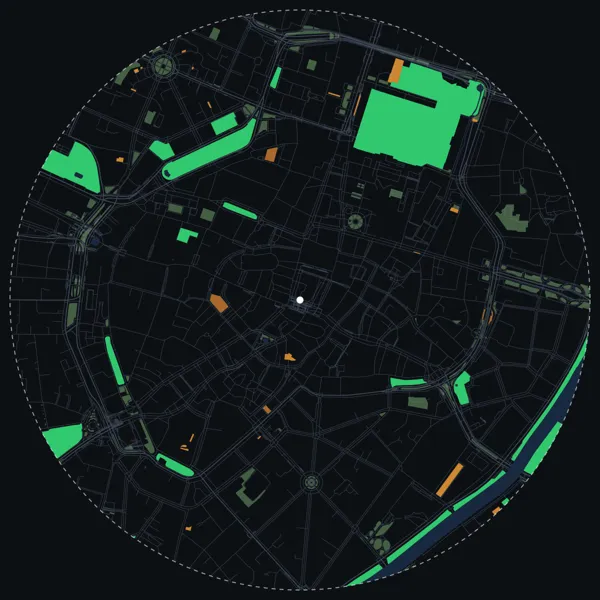
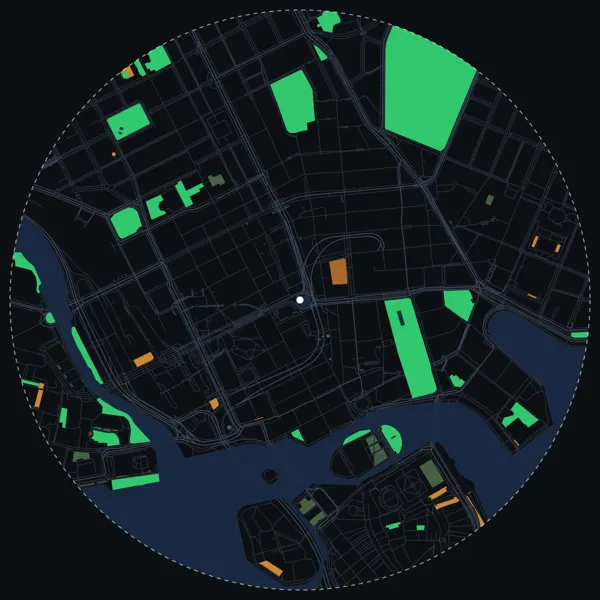
parkother greenparkingfreewaywaterstreets
Both maps at the same scale.
Side by side
| Measure | Munich | Stockholm | Better |
|---|---|---|---|
| Walkability places within a 15-minute walk | 2,520 | 1,681 | Munich |
| Parking of the land is parking | 0.4% | 0.6% | Munich |
| Parks of the land is public park | 6.2% | 8.6% | Stockholm |
| Street grid street order score (1 = perfect grid) | 0.18 | 0.19 | Stockholm |
| Freeways of the land within 150 m of a freeway | 0% | 0% | tie |
Walking
Downtown Munich is one of the most walkable centers we measured. Starting at Marienplatz, a 15-minute walk (1.2 km along real streets and paths) reaches about 2,500 shops, cafés, restaurants, schools, pharmacies and other everyday places. That is 10th of 50, and above the median of 1,610. Its blocks are average-sized: the median block is about 12,000 m², and there are about 151 intersections per square kilometer (median across all 50: 98).
Downtown Stockholm sits in the middle of our 50-city ranking for walkability. Starting at Sergels torg, a 15-minute walk (1.2 km along real streets and paths) reaches about 1,700 shops, cafés, restaurants, schools, pharmacies and other everyday places. That is 23th of 50, and above the median of 1,610. Its blocks are small: the median block is about 7,200 m², and there are about 141 intersections per square kilometer (median across all 50: 98).
Freeways
No freeway runs above ground within 1.5 km of Marienplatz.
No freeway runs above ground within 1.5 km of Sergels torg.
"Better" follows each ranking: more places in walking distance, less parking, more park land, a more regular grid, fewer freeways. A more regular grid is not always better for walking. Method.
